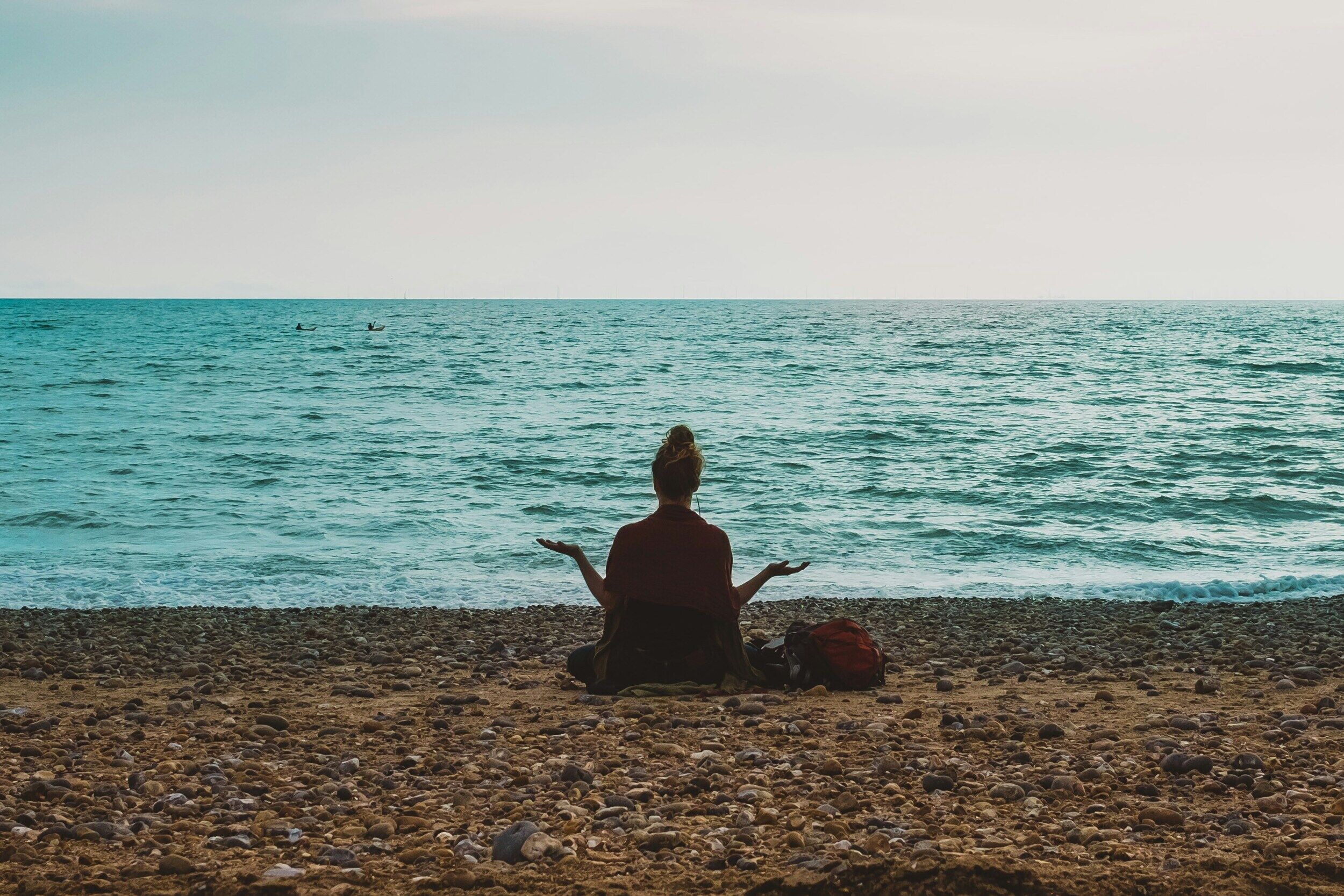
What is meditation? Recently, someone asked me if I could point them to a podcast episode I had done about meditation. And I realized something surprising. After more than 120 episodes of my podcast, conversations about healing, trauma, embodiment, relationships, personal growth, and all kinds of practices that support transformation, I had never actually recorded an episode focused specifically on meditation itself.
Meditation has been so foundational to my life and my work that I think I assumed I had already spoken about it directly. It is woven through so much of what I do and so many of the conversations I have that it became background instead of foreground. Something assumed rather than explicitly named. And yet it is often the background practices that quietly shape everything else.
While the podcast is on hiatus, I will be sharing the guided meditations I offer for free each month on YouTube through the podcast feed. Before doing that, it felt important to create a place to begin. Not as a formal teaching or expert instruction, but as a grounded explanation of what is meditation, what it actually does in real human experience, and how to begin a meditation practice in a way that is realistic and sustainable.
What Is Meditation?
What is meditation is one of the most common questions people ask when they first encounter mindfulness or contemplative practices. At its core, what is meditation can be answered very simply: meditation is the practice of training attention.
This means meditation is not about stopping thoughts, clearing the mind, or achieving a permanent state of calm. It is about learning how attention moves, noticing when it drifts, and bringing it back again and again. That process of noticing and returning is the entire practice.
Most people are surprised when they first understand what is meditation because it does not match popular assumptions. The mind does not become empty. Instead, the mind becomes observable. You begin to notice how often attention moves into planning, worrying, remembering, or imagining without conscious direction. Meditation does not eliminate these patterns. It makes them visible.
That visibility is the beginning of mindfulness. Once something can be seen clearly, it can be related to differently.
My First Experience With Meditation
I did not come to meditation through calm or spiritual curiosity. I came to meditation through somatic work over twenty five years ago, through training at the Strozzi Institute, and through early mindfulness practices in survivor support spaces.
At that time, meditation was part of the structure of training. We were expected to practice consistently between intensives, and meditation was treated as a basic part of the learning process rather than something optional or decorative.
When I first began practicing, I assumed meditation would feel grounding or peaceful. Instead, my experience was the opposite. My nervous system became more alert rather than less. I was scanning the environment, tracking sounds, and orienting toward safety rather than stillness.
For a long time, I interpreted this as failure. I thought I was doing meditation incorrectly.
What I understand now is that I was meeting a nervous system that had learned vigilance as a baseline. Stillness did not automatically equal safety for my body at that time, so my system did what it had been trained to do.
The shift happened when I stopped trying to force a different internal state and instead changed the conditions of practice. I sat with my back against a wall so I could face the door. That small adjustment reduced the internal strain enough that my attention could begin to soften.
That is where meditation actually began for me. Not in calm, but in creating enough safety for awareness to exist without constant effort.
What Happens When You Start a Meditation Practice
One of the first things people discover when they begin meditation is how active their thinking actually is. This is a central part of understanding what is meditation in lived experience, not theory.
When you sit down and begin to observe the mind, you often notice immediate repetition. Planning, worrying, rehearsing conversations, anticipating outcomes, and trying to solve problems that are not actually happening in the present moment. These patterns can feel surprising because they are usually running in the background unnoticed.
Meditation does not stop these thoughts. It reveals them.
This is one of the most important shifts in practice. Instead of being completely inside thought, you begin to notice thought as something occurring in awareness. That distinction creates the beginning of space between awareness and reaction.
Why Meditation Feels Difficult at First
Meditation is often more difficult at the beginning than people expect, and this is not a personal failure. There are two primary reasons this happens.
First, attention is not yet trained in sustained focus. It is accustomed to moving constantly between internal thoughts and external stimuli. When you ask it to remain in one place, even gently, it naturally wanders.
Second, the nervous system may not associate stillness with safety. For many people, especially those with stress or trauma history, slowing down can initially increase activation rather than reduce it. Stillness removes distraction, and without distraction, underlying patterns can become more noticeable.
This is why meditation can feel uncomfortable at first. It is not because it is wrong for you, but because it is revealing how your system currently organizes attention and safety.
Starting slowly and adjusting the practice to match your capacity is not a limitation. It is what makes the practice sustainable.
Meditation Is Not One Technique
Another essential part of understanding what is meditation is recognizing that meditation is not a single method. It is a category of attention training practices that serve different purposes.
There are breath based meditation practices that use the inhale and exhale as an anchor for attention. There are body based practices that focus on sensation and embodiment. There are visualization practices that support emotional regulation and internal organization. There are mantra based practices that stabilize attention through repetition. There are heart centered practices that cultivate emotional awareness and coherence.
Each type of meditation serves a different function. Some practices support calming the nervous system. Some support focus and clarity. Some support emotional processing. Some support developing awareness of internal states.
There is no single correct method of meditation. The most effective practice is the one that matches your current nervous system capacity and needs.
What Is the Goal of Meditation?
A common misunderstanding in asking what is meditation is assuming that the goal is to become calm, silent, or emotionally controlled. While these experiences may sometimes arise, they are not the purpose of the practice.
The purpose of meditation is to increase your capacity to stay present with experience without immediately reacting to it.
This includes all forms of experience. Anxiety, boredom, irritation, grief, calm, and joy all become observable rather than overwhelming or defining.
Over time, meditation changes your relationship to these internal experiences. You begin to notice patterns earlier. You begin to recognize thoughts as thoughts rather than truths. You begin to experience emotional states as temporary rather than absolute.
This is the foundation of mindfulness meditation and emotional awareness.
How to Start a Meditation Practice
If you are asking what is meditation and how to begin, the most important principle is that consistency matters more than duration.
You do not need long sessions to begin meditation practice. You need repeatable moments of attention that your system can actually sustain.
Start with one minute if that is what feels realistic. Five minutes is more than enough. Even brief moments of intentional awareness throughout the day can begin to shift how attention functions.
To begin, sit or lie down in a position that feels physically supported. Notice your breath. Notice sensation in the body. Notice thoughts as they arise. When attention drifts, gently bring it back.
There is no need to evaluate the experience or judge performance. The practice is the noticing itself and the return of attention.
What Changes With Meditation Over Time
With consistent meditation practice, changes tend to be gradual and subtle rather than dramatic. You may notice that you are less immediately reactive in certain situations. You may become more aware of emotional and cognitive patterns as they arise. You may begin to recognize thought patterns as patterns rather than absolute truths.
Meditation does not remove stress from life. Instead, it changes your relationship to stress. It creates a small but meaningful space between stimulus and response, which allows for more intentional choice in how you respond.
Over time, this shift can influence relationships, decision making, and emotional resilience.
Final Thoughts on What Is Meditation
What is meditation is not a technique to master or a state to achieve. It is a practice of returning attention again and again to the present moment.
You will get distracted. You will forget. You will return. That cycle is not failure. That cycle is the practice.
Meditation is not about becoming someone different. It is about learning how to be present with who you already are in a way that is sustainable, grounded, and real. And it begins exactly where you are, with whatever attention you can offer right now.
Learn More
If you’d like to explore meditation, embodiment, and healing practices more deeply, listen to the LaidOPEN Podcast and explore my courses, workshops, and monthly meditation offerings at PassionateLife.org and CharnaCassell.com. You can sign up to be notified about live meditation I do the first Wednesday of every month at 9:00 am PST here.
TLDR/ Frequently Asked Questions
What is meditation?
Meditation is the practice of intentionally directing your attention to develop awareness, focus, and presence.
How long should beginners meditate?
Many beginners start with one to five minutes per day and gradually increase their practice over time.
Is meditation the same as mindfulness?
Mindfulness is one form of meditation, but meditation includes many different practices such as breathwork, visualization, and mantra repetition.
Can meditation reduce stress?
Many people find that meditation helps them feel calmer, more grounded, and less reactive to stress.