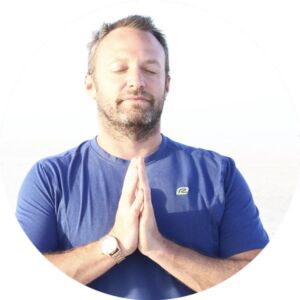
Soft-belly breathing meditations can be supportive in many ways.
I place my hand under my belly button and breathe into it. Reading about soft-belly meditation practice to relax fear and feel our aversion to discomfort, brings me back to the practice I started when I was twenty-six. An Iyengar yoga teacher told me about placing my hands on my belly and breathing into them to help with constipation.
I’d struggled with lifelong constipation and even impacted bowels as a 6-year-old. With this practice, I could barely make it through my 40-minute meditation before having to run to the bathroom.
Until then, my body didn’t know how to let go, how to slow down and release instead of functioning as a receptacle for other people’s pain. Starting in utero, it performed this habitual task of holding on.
To be of value, it had to hold everything and everyone and this prevented peristalsis. I unconsciously chose discomfort in my body. Learning to be with my body and emotions, rather than dissociating from internal experiences, didn’t begin until I discovered meditation and somatic bodywork.
While I did not specifically do soft-belly practices to release fear at twenty-six, it makes sense that during a time that I was engaging in regular yoga, somatics, and meditation, I began to feel safer in my body, poop with more ease, and feel less fear. Breathing into my belly, dropping down through my pelvic floor, into the groundedness of the earth, tethered me in a way I’d never been rooted by my parents or a childhood home.
Stephine Levine, in his book “A Year to Live”, describes the belly-heart connection as a plate of armoring along the front of the body. I think of it as protecting that “soft animal of your body” that Mary Oliver speaks of in her poem Wild Geese.
We have these tender undersides that are always exposed when we stand upright compared to other mammals, who only expose their bellies when they feel safe. No wonder 15% of the US population has IBS. Clenching and hardening our guts long past the days of wearing literal armor is our only protection.
Until I learned how to stop contracting, compressing, and holding my breath, I didn’t even realize that was my default way of being. Even with more somatic awareness, riding a bike for the first time at thirty, reactivated old habitual fight/flight/freeze responses.
Navigating traffic, I quickly understood where the term white-knuckling came from. My jaw, shoulders, pecs, arms, and hands ached when I got off that bike. It was as if I was trying to control my bike and prevent crashing into pedestrians and parked cars through magical thinking and squeezing my body tightly.
I didn’t trust myself to find balance or trust others to be alert and take care of themselves. I’d been so disembodied and disconnected from emotions, pain, and signals for the first twenty-four years of my life, my daily bike commute became a practice in self-trust and unwinding fear.
Coasting downhill at dusk was my favorite moment of the day. The crisp wind on my face during winter, and the breeze on my bare sweaty limbs during summer, called me into the present moment, smiling in gratitude for internal balance and confidence.
Soft-belly breathing now, I ask, What am I afraid of? Even when I think my lower belly has released, it repeatedly locks out of habit and social conditioning that says suck it in and suck it up. As belly softens, words bubble up.
Single words appear jumbled and refuse to form sentences. I know physical suffering as I’ve lived through it. I know terror as that was the tone of my childhood. Worrying was the religion I was raised with and have refuted. I’m a born-again optimist and conjurer of what I want. And still:
What if after centering my life around being of service with my soft-belly breathing, I don’t create the sustainable change or make the difference I want to see in the world?
What if I don’t increase enough people’s understanding of trauma and the collective awareness doesn’t change? Fulfilling my purpose helps me make sense of the
suffering I’ve experienced.
If we strip down to the soft animal of my body:
I’m afraid that being of service may not be enough.
I’m afraid I won’t have a long-term mutual love of my life.
I’m afraid I’ll die alone and no one will find me for days.
I’m afraid I’ll never get to express and share the kind of love I have to give to a child.
If I were to die in a year, I would have cleared a monumental amount of karma, but what tangible contribution have I made when the people I support die and take their memory of me with them? Is the change in their nervous system and how they show up for their communities enough?
Or is something concrete, such as digital or written material essential to have an ongoing impact? I want to have created an actual ripple in societal beliefs around what causes trauma, what it is and facilitate more empathy and collective care.
These fears rumble and gurgle in my intestines. My chest tightens above them. I part my lips and exhale. I am so human. Another part of me thinks You are enough. It is enough. Let the fear be there. Let the grief be there. Keep being with it and breathing around it. It can seem like what you’ve planted will never sprout or root but sometimes seeds lay dormant for years before blooming.
I think of growing asparagus and peonies, and my work with teenagers. It can take years and then you’re surprised by what you actually cultivated with your attention and care.